
Jake Sannes
The Pattern
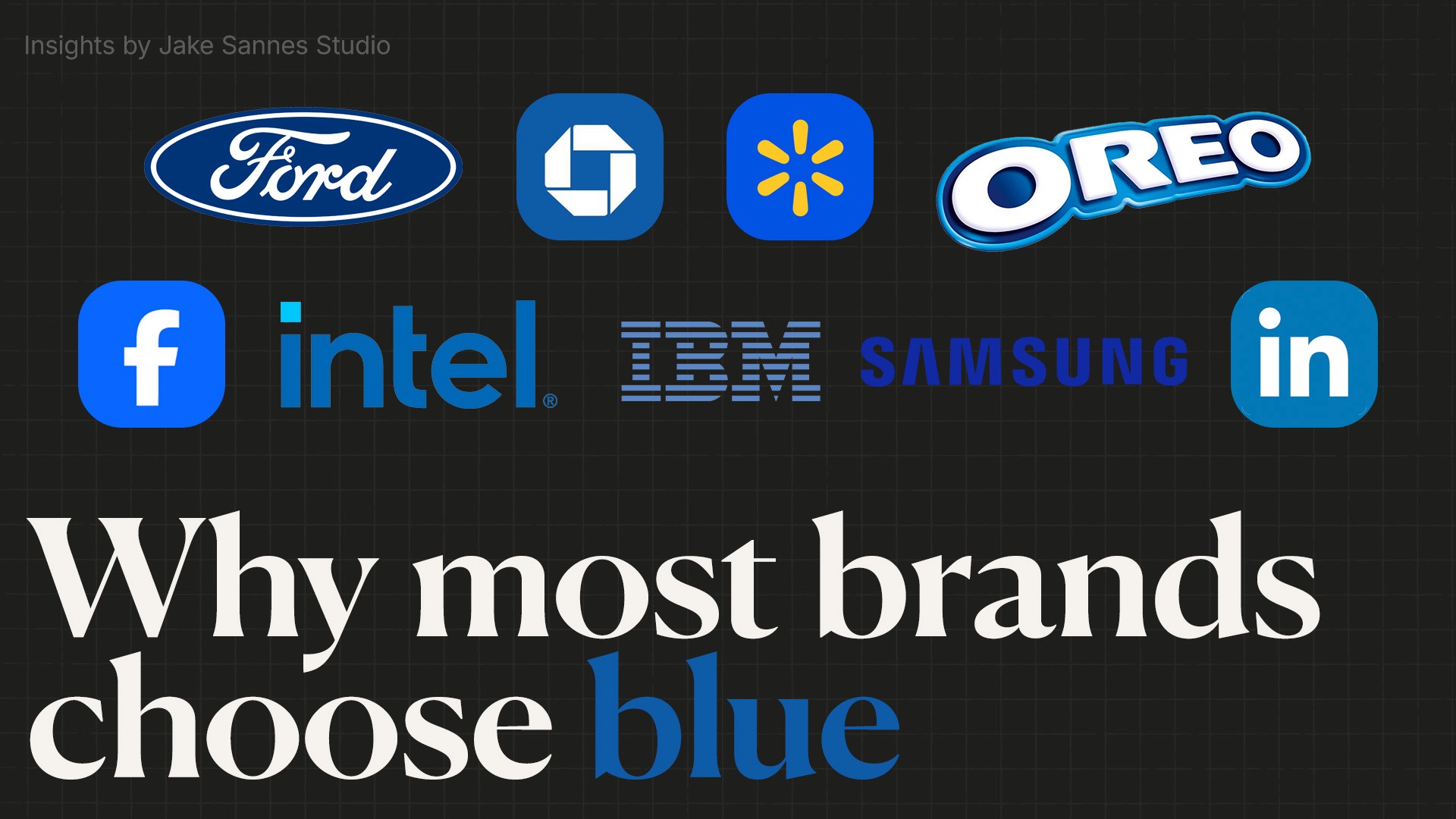
It doesn’t take long to notice how widely blue is used across industries. From American Express to Oreo, the color appears everywhere. It is the most used logo color among brands, showing up in more than a third of all identities. Ranking as the number one color in branding, it raises an important question:
Why blue?
The Default
In color psychology, blue signals trust, stability, competence, intelligence, and security. In high-risk or high-stakes industries, those attributes are invaluable. Financial institutions rely on it for a reason. People want to feel that their money is safe and that their bank is dependable. PayPal. Visa. Capital One. Citi. The pattern is consistent.
Design should always be informed. Credibility is something every company wants, so the palette becomes limited. Consciously, or more often subconsciously, blue becomes the obvious choice. It reduces friction. It mitigates perceived risk. Over time, it has become the shorthand for legitimacy.
But when shorthand becomes default, strategy quietly shifts.
Sameness
Trust is foundational in business. Without it, nothing works. But if every brand signals trust in the exact same way, the signal weakens. Humans are perceptive. When everything looks stable and credible, nothing feels distinct.
Choosing blue optimizes for approval. It does not necessarily optimize for position.
When everyone claims the same emotional territory, no one owns it. Entire categories begin to look interchangeable. This is not the fault of any single designer or founder. It is the natural result of mimicry. When something works, it gets repeated. Over time, repetition becomes convention.
The 99%
The issue is not blue itself. Blue works. It has built enormous brands and continues to do so. Companies like Facebook or Ford carry decades of equity tied to that color. For them, it is embedded into memory and meaning.
But most companies are not legacy giants. The Fortune 500 represents less than 0.002 percent of businesses in the United States. The remaining 99.998 percent operate in intensely competitive environments where differentiation is survival.
Position Over Approval
In that landscape, copying the visual language of the most dominant players may not be the smartest move.
Strategic color selection is not about avoiding trust. It is about defining a position. There are many ways to communicate safety, credibility, and intelligence without defaulting to the same hue as everyone else.
The Real Problem
Safety optimizes for approval. Strategy optimizes for position.
If long-term brand equity is the goal, color should be chosen deliberately, not defensively. Blue is not the problem. Default thinking is.
If your brand could benefit from revisiting its color strategy, the solution is not simply choosing something different. It requires understanding positioning, perception, and long-term equity. Thoughtful shifts, when grounded in strategy, can elevate a brand far beyond surface-level change.
At Jake Sannes Studio, brand systems are built with that foundation in mind. Every decision, including color, is evaluated through the lens of differentiation, scalability, and strategic intent. The goal is not to stand out for the sake of it, but to define a position that holds up over time.
More Like This
" width="1200px"/></svg>)
" width="1200px"/></svg>)